Monday, May 7, 2018

SFB: Converting Lyran Tugs Into Lyran Tugs

A little ways back I ordered a Lyran Cougar transport tug and a light cruiser with intentions of performing conversions on both models.  These are metal versions of the miniatures from ADB's Starline 2400 series.

The Cougar is basically a Heavy Cruiser hull with the addition of two plain, very low profile cargo pallets. I plan to run my Cougars as Battle Tugs most of the time, and decided that I would modify one of the pallets into a Battle pallet.  After receipt of the model, I conducted a search for depictions of the Lyran BT, and using that as inspiration, I decided to scratch-build a new pallet for the Battle tug.

Lyran Cougar Tug as received from ADB, with two cargo pallets.

I started of by cutting off the base mounting lug on the underside of the hull, and adding some structure to the underside of the hull, such that the pallet wouldn't interfere with the impulse engines.


I estimated dimensions for the Battle Pallet, and shaped the "U" shaped pallet from styrene sheet.  Detailing was added using the SSD as a guide with respect to weapons and other features.

My scratch-built battle pallet, next to the original cargo pallet.


The battle pallet attached to the ship, a hole was drill in the underside of the pallet to receive the mounting post from the base.

I'm pretty happy with the finished model, a reasonable interpretation/representation, I think.


I then converted a Light Cruiser into a Puma using the same process, first modifying the underside of the hull, and then adding a simpler scratch-built cargo pallet, resulting in the following model.


And a comparison shot of the two.


Saturday, May 5, 2018

SFB Miniatures, A Few Kzinti Conversions

During my recent binge of starship building, I completed a few minor Kzinti conversions.  The first was to convert a frigate into a scout by adding a second sensor dish under the front of the ship.


The other two conversions were to turn two frigates into drone frigates by adding additional drone racks/launchers on stubs extending from the hull just forward of the lower warp engines.


These were converted using styrene and brass wire from the metal Starline 2400 ships from Amarillo Design Bureau.   


Wednesday, May 2, 2018

SFB AAR 7-1: Collateral Damage

This massive battle was the culmination of seven turns of maneuver and skirmish, setting up the largest star Fleet Battles game that we had ever played against each other (in 38 years o play).  My combined Lyran/Klingon force consisted of 59 vessels facing 56 Kzinti warships.

Prior to the start, my expectation was that the battle would likely only last a turn, with whichever side finding themselves at a disadvantage at the end of the first turn, likely breaking contact and disengaging.  From the Lyran perspective, it was imperative to inflict as much damage as possible, as quickly as possible, without too much concern for losses, as long as an advantage could be achieved.

The Kzinti setup in roughly the center of our table, a screening force of battlecruisers in the lead, followed by two groups of carriers and escorts in side by side wedges. The entire group was tractoring fighters, such that more than a hundred of them would be available at the required time.  It was a very threatening site.

My forces were split into two groups, based on point of entry into the strategic hex.  A combined Lyran/Klingon force of 31 ships to the front of the Kzinti, and a smaller, and much lighter force of  28 ships on the Kzinti Left flank.

Early in the first turn.  The Kzinti (top center) have already started their
right turn towards the Lyran "flanking force" (left).  The combined
Lyran/Klingon force (lower right) never gets into the fray. 


At the time of initial setup, I envisioned that my mixed force would take a pounding, and feared that the flanking force would not close rapidly enough to have significant impact on the battle.

In the early impulses of the first turn, the Kzinti force turned sharply to the right to face my smaller force, leaving me to believe that my original assessment would still hold true, but with the role of my two forces reversed, and probably with even more favorable results for the Kzinti forces.

Each of my forces were deployed with a screen of lighter ships spaced two to three hexes apart and three to four lines deep, in an effort to maximize drone and fighter interception.  The Kzinti had at least 128 fighters and the capability to fire over 300 drones per turn. Larger Lyran ships followed the screen in three or more rows, but with spacing of one or two hexes, with generally the rearmost ships having more than one ship per hex.  This was in sharp contrast to the Kzinti formation, that featured four or five ships per hex, all more tightly packed than mine.

Through the first half of the first turn, the game progressed more or less as I had anticipated, and to be honest, did not look good for me.  My only saving grace to this point, was that after the turn, the Kzinti forces were awkwardly positioned, with their lethal force of 15 battle cruisers were at the farthest range from my forces.

As the fleets closed, I started losing screening ships at the rate of one every 1 to 2 impulses, each screening ship focusing their fire on a single, specific, Kzinti light cruiser, and deploying as many transporter bombs ahead of the enemy as possible as soon as their shields were breached.

Finally, after loosing about 5 ships, all police corvettes and frigates, I compounded enough fire to destroy an enemy CL, the explosion of which, caused shield damage to a number of Kzinti ships and destroyed a few of the drones which were starting to be launched.

My screening force largely vaporized, this is around the time that the
first Kzinti Cl was destroyed.  The Kzinti BCs are spread out toward the lower
right of the photo, the CVs and escorts more congested at the upper right.


By the time I destroyed a second CL, I had lost about 8 ships, and was becoming concerned. I had deployed a number of transporter bombs, and nothing larger than a DD had been lost, but the situation looked to only get worse, as the Kzinti would soon be in range to start picking on my bigger boats with their biggerer boats.

A couple of Lyran CLs were now in range as the Kzinti closed and started to hit the transporter bombs.  My CLs would be lost, but would take another Kzinti CL with them, and reach a turning point in the battle.  At this point the explosions of the Kzinti CL s began to breech the shields of a number of the Kzinti frigates in the group, which began taking internal damage.

With the passing of each impulse, more heavier Lyran ships came into range, and combined with the damage of transporter bombs, began to cause serious damage to Kzinti ships.  Each impulse another Kzinti frigate was destroyed, causing collateral damage on many of the tightly packed ships.

Kzinti maneuver was hampered by the transporter bombs, but finally the Kzinti made a hard right turn to move out of the exchange.  Regardless of which way they turned, a number of frigates would expose their destroyed side shields to several Lyran CEs, CAs, and a couple of heavier ships.

Shortly after having turn away from the Lyrans, Kzinti ships
start to go off like popcorn.

On the next impulse three more frigates exploded, taxing the shields of CVs, DNS, and other Kzinti heavy ships, and an impulse later, three more frigates were gone, breaching many shields on heavier ships.  The exploding frigates caused other frigates to explode, in turn causing more collateral damage to the bigger ships, which also started exploding like kernels of popcorn in a galactic microwave oven.

In the span of a single turn, 38 Kzinti ships were destroyed, for the loss of 11 Lyran,  even before the situation got ugly, the Kzinti player recognized the problem, but the large number of tightly packed ships, and placement of the transporter bombs gave them no out.

Had this been a more typical battle with 15-30 ships per side, it would have turned out very differently, the heavy ships would not have been at risk, and could have continued to methodically smash my Lyrans, probably erasing the Lyran force at a cost of maybe a dozen ships.  It was a very interesting game, that neither of us anticipated, despite the hundreds of SFB games that we have played over the years.

Losses were as follows:

Lyran
4x Pol
2x FF
2x DD
1x DW
2x CL

Kzinti
2x DN
4x CV
1x CVT
2x TT (possibly CVT or BT)
2x CVL
4x CVE
4x CC
3x CL
3x DF
4x FF
9x EFF
4x LF
3x SF
3x L Q-ship (I think)

The implications of this battle are huge. The Kzinti have meager forces with which to stop the Klingon invasion of their space, their invasion of Lyran space is no longer a significant threat, and their surviving forces are cut off and need to contact and be resupplied by the invading Hydrans to avoid being dead in the water in two more turns.

The Lyrans are still in hot water though, as they are out-numbered and out-classed by the invading Hydran force, and will have to fight tenaciously, to wear down the Hydrans.  

The Klingons are in the best position to benefit at the moment, with Kzinti space almost up for grabs, and the potential of the Hydrans and Lyrans wearing each other down, possibly freeing up more space for the taking. 


Thursday, April 26, 2018

A Lyran Fleet for Star Fleet Battles

I recently completed the core of a Lyran fleet for Star Fleet Battles.  This is a mix of newer castings combined with a few models that painted 34 years ago.  I experimented with one model, giving it a much more realistic, weathered treatment, and though it looked much more realistic, it didn't go well with my old models from the 1980s.  And since this project is a bit of a nostalgia trip for me, I decided to just give the models the more simple paint jobs, matching my 1980s models.  Here is the fleet at the moment:


I still need to add decals which I failed to order in time for my painting frenzy.  Once I remembered to order them, Jupiter IV shipped them quickly and in good order, and I hope to apply them while adding a few conversions to my Lyrans in the near future.


Monday, April 16, 2018

An Airplane Too Many

Ever since I started on my 15mm third-world imagi-nation campaign, I've been slowly acquiring 1/100 scale aircraft models for my campaign and other post WWII games.

It started with two pair of Tamiya kits, two Mig 21s and a couple of G91s.  Since then, the heap has been growing steadily with more aircraft for Africa, and others for NATO-WarPac and Soviet Afghan games.

Over the years, I had built-up 24 aircraft, while shelving far more for future use.  For the longest time, I kept track of it all in my head, but over the last year, it started to get a little fuzzy.  Then, a couple of weeks ago, I was surprised to find an Alpha Jet in the heap, and realized that the limits of my memory had been exceeded.  So, I decided that it was time to take inventory.


I now have a list of all of the kits in my heap, and it was nice to discover an extra Super Mystere and A4E Skyhawk.  Currently, the heap totals 101 plastic and resin kits, with the newest additions being a French Puma, and a couple of QRF's new Mig 17s.

Guess I'd better get to work.

Wednesday, April 11, 2018

An Evening of Casting

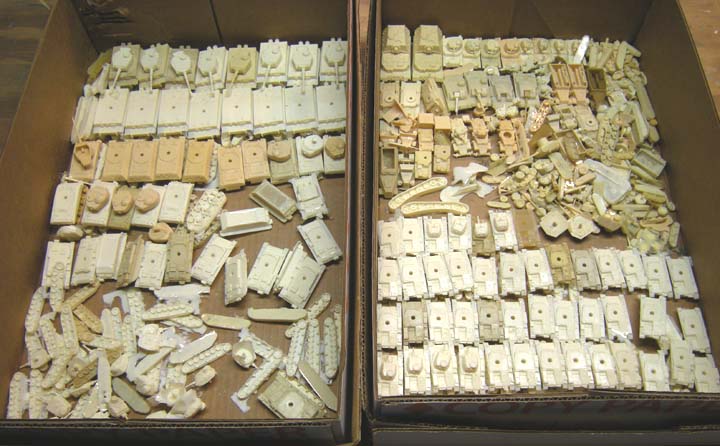
So, I needed some stands to make any headway on my starships for Star Fleet Battles,  But, I only have one set of molds for the bases, and it takes 20-25 minutes per casting pass. So I pulled out a bunch of my old WWII vehicle molds, and figured that I'd finish some of those WWII vehicles than I've been meaning to make for 30 years.

Four hours later, I had eight starship stands, 20 new 15mm WWII vehicles, and parts towards a bunch more.

One evening's casting.
 
The hex base stands for the starships.
 
I got out my parts boxes and matched parts for an additional 44 vehicles.

Parts boxes of previously cast bits.
 
My new hex bases and 64 new WWII vehicles awaiting assembly.
 
The parts are now all cleaned and assembly will take place over the next couple of evenings.  Hopefully I'll be back to starships by this weekend, and I have a year's supply of WWII vehicle to paint.

Monday, April 2, 2018

Fortifications for a Scavenger Village

Over the last month, l've been working on fortifications for a 28mm post apocalyptic scavenger village.  The main feature is a set of modular walls to enclose the village.  Additionally, there will be some fighting positions, a couple of towers, and some interior dwellings and buildings, when it is all done.

When I started working on this, I didn't appreciate how time intensive this project was going to be, so I've broken it down into a group of smaller projects to facilitate making some progress on some other projects as well.

The idea was to build two sheet metal walls utilizing posts made from steel structure, planted in the earth, and filling the space between the sheet metal with rock, gravel, and soil, as a barrier against gunfire and lesser missiles.  These could be defended from a few raised fighting positions, made of steel, and some other makeshift positions, consisting of boxes, barrels, and other clutter.

Other interior structures include a couple of observation towers, a workshop, stores, and a couple of dwellings.  These structures will be the subject of further posts.

Construction is mostly of styrene plastic steel shapes and patterned plastic sheet.  The fill was made of foam, topped with a mix of model RR ballast.  Here are photos of the work:

 
I started with lengths of steel shapes (little piles in top of photo) cut to lengths around 2 inches, pattern sheet scraps cut to about 1.3 inches width, and made bases for the main wall sections measuring 1.25 x 4 x .06 inches.  Other base sections were added as needed for the gates, corners, etc.
 
 
The photo above shows construction of the sheet metal walls mostly complete.
 
 
A view after adding in the rock fill.  This was done by gluing in blocks of EPS foam between the steel walls, and gluing a layer of various sizes of ballast on top.


After some discussion on the Post Apoc Wargames Forum ( a fantastic gaming forum by the way), I decided to add the fighting positions and started on the observation towers as well.

 
Above with most of the painting done on the walls, a seemingly endless task that tied up most of my free time for about two weeks. 
 
By this time the project was taking notably longer than I had expected ( I had allowed about 17 days and was into four weeks and not done yet), was tying up my game table, and holding up other projects and games. So, I decided to finish the towers and inner buildings later.  Gates will probably come in time as well.
 

Almost done, the rock fill is painted and a layer of rust and dust has been partially added.

And finally, Rust, dust and flock, added, I'm calling the walls done below.


The last photo shows the basic wall sections; corners, 4" walls, the rear gate, a 2" end cap, and the front gateway to the rear of the group.  The parts are modular, such the geometry can be changed to meet the need.
 
  In addition to all of the work, I was slowed by a bottle of super glue that never set up (even when sprayed with accelerator); running out of my favorite solvent, and discovering the replacement had a filler in it, that clogged my syringe with the application of each drop; and a cat that enjoyed scattering all of the little cut bits, before the assembly was done.  I'm really glad to have the walls done.

The towers are on my painting table, but need some additional bits added on, before painting can resume.  The inner buildings are sketched out, and some of the plastic has been cut, but guessing that I have a month's work to do, before getting to their construction.  And with any luck, I hope to get a couple of games on the table in the next couple of weeks.