My sole gaming accomplishment in the last two months has been to paint some Centurion Mk IIIs for Uwanda's Army.
These are the 20pdr armed Centurion Mk III models from QRF and are quite nice. The model comes in six pieces including the side skirts, which I opted not to use, as I expect to eventually have later 105mm armed Mk V, and want to readily distinguish between the two versions.
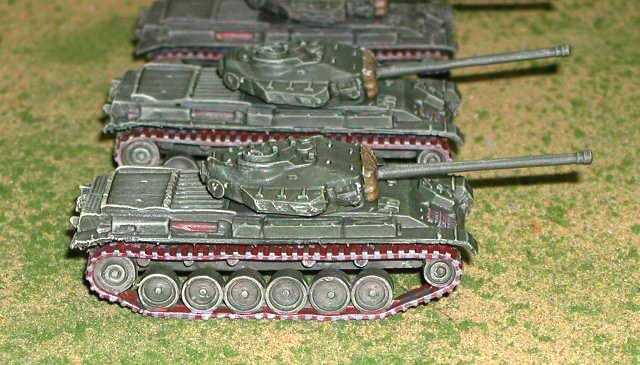
Though not the most modern tank in Uwanda Army service, these Centurions make up the heart of the Uwanda's armored formations, and have proved to be more than a match for Mugabia's T34/85s. They will play an important part in upcoming battles between the two imagi-nations.
Above the Centurion is pictured with the other tanks in Uwandan service. The Sherman Firefly (left) from Gaming Models, and the Vickers Mk III (right) from QRF.
Monday, June 27, 2016
Sunday, June 26, 2016
Tinkering With Air Combat Rules
For many years, I've wanted to play a detailed modern (jet age with some missiles) air combat dogfighting game, and have tried a few air combat games with jets at conventions, some quite enjoyable, but none providing the same level of enjoyment for me as Mustangs & Messerschmitts WWII dogfight rules.
I had played the Korean era game once at a convention, but never managed to get the Korean supplement for M&M before Rocky Russo passed. Guess I realized that as I aged, my knees just weren't up to the up-and-down action required by playing the game on the floor. Rocky of coarse, never added a missile era supplement for M&M, Vietnam and the Cold War gone hot were never an option with that system.
Some years ago, I created a very simple air combat resolution system (simple in presentation, probably over detailed in content), to support tabletop land battles. But the system dispassionately dispenses with any real playing of the dogfights or engagements. Once the interaction is generated through a 2-D map, the dogfight can be resolved in 2-3 consecutive die-rolls. Mostly a statistical way to generate air superiority for close air support on the table top.
Anyway, during my downtime over the last few weeks (been sidelined with a series of ailments), I've started hammering out numbers, mechanics, and bits for a modern air combat game that will allow players to actually maneuver their aircraft. As I've gotten into this, I've realized that it may simply be too complex to present accurately as a table top miniatures game, but computer simulation just doesn't do it for me, and reducing air combat to three four or five values on the table top doesn't do it for me either.
At this point, I've worked out scale, some mechanics for flight and maneuver, and basic stats (about 20 numbers for a given jet) for about 10 aircraft, consisting of post Korean era 1950s and 1960s designs used in my imagi-nation Mugabia-Uwanda war.
This is for the tabletop, requiring a 5'x6' or larger (6'x10-12' would be more ideal), using 1/285 and 1/300 scale models on small flight stands. The stands currently feature a two inch base with an 18" tall post, and the plane is mounted on the post with a clip that permits depiction of angle and orientation of flight. It is similar, but much smaller than the clips from M&M or Fighter Pilot.
The system will allow for AAMs, but is intended to focus on dogfighting and short range missiles. Longer range missile engagements can be resolved, but such battles will probably take the shape of WWII carrier duels at sea, with volleys of missiles resolved with one side's aircraft "fleet", and then the opposite, potentially with both sides aircraft never being on the same table or "battlefield" at the same time.
In this first iteration, turns and movement will be controlled via small templates. I expect that this will work fine for 1 on 1 and even 2 on 2 battles, though I wonder if larger battles with maybe 6-12 aircraft will be too cramped for space to accommodate the templates. I have an alternative base design that will involve a single movement point roller and turn mode markings to eliminate the templates, but hope to find that the more complex bases are not needed. The base size is targeted at a 2" square.
I've already accepted that there will be some loss of detail and accuracy with respect to specific aircraft advantages in specific altitude bands, and that there will be some ignoring of speed/energy issues impacting performance, I just haven't hammered out how much inaccuracy is required to result in a playable game. In the end, it will be a compromise to make a playable game that still captures the flavor of the dogfight.
Once I get the basics worked out, and if they are workable, I will expand the stats for Korea through at least the early 1970s and hope to make the rules available as a free PDF.
Hopefully, it will work out.
I had played the Korean era game once at a convention, but never managed to get the Korean supplement for M&M before Rocky Russo passed. Guess I realized that as I aged, my knees just weren't up to the up-and-down action required by playing the game on the floor. Rocky of coarse, never added a missile era supplement for M&M, Vietnam and the Cold War gone hot were never an option with that system.
Some years ago, I created a very simple air combat resolution system (simple in presentation, probably over detailed in content), to support tabletop land battles. But the system dispassionately dispenses with any real playing of the dogfights or engagements. Once the interaction is generated through a 2-D map, the dogfight can be resolved in 2-3 consecutive die-rolls. Mostly a statistical way to generate air superiority for close air support on the table top.
Anyway, during my downtime over the last few weeks (been sidelined with a series of ailments), I've started hammering out numbers, mechanics, and bits for a modern air combat game that will allow players to actually maneuver their aircraft. As I've gotten into this, I've realized that it may simply be too complex to present accurately as a table top miniatures game, but computer simulation just doesn't do it for me, and reducing air combat to three four or five values on the table top doesn't do it for me either.
At this point, I've worked out scale, some mechanics for flight and maneuver, and basic stats (about 20 numbers for a given jet) for about 10 aircraft, consisting of post Korean era 1950s and 1960s designs used in my imagi-nation Mugabia-Uwanda war.
This is for the tabletop, requiring a 5'x6' or larger (6'x10-12' would be more ideal), using 1/285 and 1/300 scale models on small flight stands. The stands currently feature a two inch base with an 18" tall post, and the plane is mounted on the post with a clip that permits depiction of angle and orientation of flight. It is similar, but much smaller than the clips from M&M or Fighter Pilot.
The system will allow for AAMs, but is intended to focus on dogfighting and short range missiles. Longer range missile engagements can be resolved, but such battles will probably take the shape of WWII carrier duels at sea, with volleys of missiles resolved with one side's aircraft "fleet", and then the opposite, potentially with both sides aircraft never being on the same table or "battlefield" at the same time.
In this first iteration, turns and movement will be controlled via small templates. I expect that this will work fine for 1 on 1 and even 2 on 2 battles, though I wonder if larger battles with maybe 6-12 aircraft will be too cramped for space to accommodate the templates. I have an alternative base design that will involve a single movement point roller and turn mode markings to eliminate the templates, but hope to find that the more complex bases are not needed. The base size is targeted at a 2" square.
I've already accepted that there will be some loss of detail and accuracy with respect to specific aircraft advantages in specific altitude bands, and that there will be some ignoring of speed/energy issues impacting performance, I just haven't hammered out how much inaccuracy is required to result in a playable game. In the end, it will be a compromise to make a playable game that still captures the flavor of the dogfight.
Once I get the basics worked out, and if they are workable, I will expand the stats for Korea through at least the early 1970s and hope to make the rules available as a free PDF.
Hopefully, it will work out.
Wednesday, May 4, 2016
What Is This Ogre Looking Thing?
Recently, when rummaging through my old fantasy figs, I stumbled across this:
A friend gave it to me some years ago, and after setting for a bit, I painted it. Unfortunately, I had stopped playing fantasy games by that point. It is a resin casting, very nicely done, I don't remember any blemishes in it, nor how many pieces it was in, if more than one. It stands about 4-5 inches tall. Does anyone know what it is, or who made it?
Saturday, April 30, 2016
28mm Scavengers of the Post Apocacalypse
I squeezed out a little time last Sunday and tonight and finished a couple of Reaper figs for my post-apoc scavengers.
Really nicely sculpted figs by Julie Guthrie, Evie and Hans of the Chronoscope line.
Here's the rest of the crew, mostly Copplestone figs that I painted sometime back.
They subsist, located in the old ruins, reluctant to relocate in any of the new or revived communities in the region. They do trade with the nearest townspeople, and thus far, have fended off various gangs, and ruffians. They are known for finding and trading highly sought after and rare items from before the cataclysm.
I still have about a another dozen figs to add to their numbers, that will give them scouts, a couple heavier weapons, and make them a little more diverse.
Really nicely sculpted figs by Julie Guthrie, Evie and Hans of the Chronoscope line.
Here's the rest of the crew, mostly Copplestone figs that I painted sometime back.
They subsist, located in the old ruins, reluctant to relocate in any of the new or revived communities in the region. They do trade with the nearest townspeople, and thus far, have fended off various gangs, and ruffians. They are known for finding and trading highly sought after and rare items from before the cataclysm.
I still have about a another dozen figs to add to their numbers, that will give them scouts, a couple heavier weapons, and make them a little more diverse.
Labels:
28mm,
chronoscope,
copplestone,
post apoc,
Post Apocalypse,
Reaper,
Scavengers,
survivors
Sunday, April 10, 2016
Fantastical Thoughts and Other Odds and Ends 4-10-16
Did a little bit of everything today; cleaning, sorting, painting and building (well, everything but gaming).
During my sorting and cleaning, I came across some Tom Meier elves that I bought some years ago to give me a break from using dwarves against my daughter' Orcs. As it turned out, she started to lose interest in gaming shortly after that, so I only ever painted a single elf. This was a test run for a color scheme.
These are really nice figs, with outstanding fine detail; I didn't do it any justice. He stands about 31mm tall from bottom of foot to top of the white portion of the helmet. At the time, there were three basic styles, with variations in helmet, and armor, and each came as spearmen on foot, mounted, and bowmen. Looking at the site now, it doesn't look like all of these are currently available, though some of the figs are, as well as other wonderful sculpts from Mr. Meier at Thunderbolt Mountain Miniatures .
Some of my earliest miniature gaming took place as an off-shoot of D&D with fantasy miniatures. I largely drifted away from fantasy in the 1980s, despite buying a bunch of dwarves for an abandoned consideration of Warhammer by my old gaming group in the 1990s. And even with revisiting it during my daughter's brief interest, I haven't seriously gamed fantasy miniatures in decades.
Over the last year, I have been resisting a draw to re-explore fantasy miniatures, and from time to time, have pulled out old plans for an elven village, dwarf fortress, and other models conceived for that Warhammer expedition.
A couple of days ago, I ventured to the local hobby shop, which has started carrying Ral Partha and Ironwind figs and army packs, and almost bought a bunch of 25mm orcs and goblins on the spot. Many are figures that I used in those D&D games, all those years ago. Today, when I stumbled onto the tray with the lone painted elf and his brethren, it seemed a fateful coincidence. A draw, slight at first, then more intoxicating as I considered the elves spread across the tray, seeing them as they might appear, with proper paint, defending their home from the forces of evil. I fear that it is only a matter of time before a new quest begins...
And in other news, I managed to get paint on a few things, finishing my modified 15mm Jeep TOWs in the process:
I also discovered that the few pots of GW paint that had bought over the years had all solidified. Their place on the painting table quickly taken by the Vallejo bottles that I found on close-out at Hobby Lobby yesterday for 39 cents each. WOO-HOO!
My other big success of the day was building a mate to my ZU23/T34 conversion for my African imagi-nation army. I originally started two of them, completing one, and losing the other in my basement flood a couple of years back. In an effort to use up a few pieces-parts sitting on my table, I built a second model for the Mugabian army. Here it is after construction:
Now lets see how many years it takes to get it painted.
During my sorting and cleaning, I came across some Tom Meier elves that I bought some years ago to give me a break from using dwarves against my daughter' Orcs. As it turned out, she started to lose interest in gaming shortly after that, so I only ever painted a single elf. This was a test run for a color scheme.
These are really nice figs, with outstanding fine detail; I didn't do it any justice. He stands about 31mm tall from bottom of foot to top of the white portion of the helmet. At the time, there were three basic styles, with variations in helmet, and armor, and each came as spearmen on foot, mounted, and bowmen. Looking at the site now, it doesn't look like all of these are currently available, though some of the figs are, as well as other wonderful sculpts from Mr. Meier at Thunderbolt Mountain Miniatures .
Some of my earliest miniature gaming took place as an off-shoot of D&D with fantasy miniatures. I largely drifted away from fantasy in the 1980s, despite buying a bunch of dwarves for an abandoned consideration of Warhammer by my old gaming group in the 1990s. And even with revisiting it during my daughter's brief interest, I haven't seriously gamed fantasy miniatures in decades.
Over the last year, I have been resisting a draw to re-explore fantasy miniatures, and from time to time, have pulled out old plans for an elven village, dwarf fortress, and other models conceived for that Warhammer expedition.
A couple of days ago, I ventured to the local hobby shop, which has started carrying Ral Partha and Ironwind figs and army packs, and almost bought a bunch of 25mm orcs and goblins on the spot. Many are figures that I used in those D&D games, all those years ago. Today, when I stumbled onto the tray with the lone painted elf and his brethren, it seemed a fateful coincidence. A draw, slight at first, then more intoxicating as I considered the elves spread across the tray, seeing them as they might appear, with proper paint, defending their home from the forces of evil. I fear that it is only a matter of time before a new quest begins...
And in other news, I managed to get paint on a few things, finishing my modified 15mm Jeep TOWs in the process:
I also discovered that the few pots of GW paint that had bought over the years had all solidified. Their place on the painting table quickly taken by the Vallejo bottles that I found on close-out at Hobby Lobby yesterday for 39 cents each. WOO-HOO!
My other big success of the day was building a mate to my ZU23/T34 conversion for my African imagi-nation army. I originally started two of them, completing one, and losing the other in my basement flood a couple of years back. In an effort to use up a few pieces-parts sitting on my table, I built a second model for the Mugabian army. Here it is after construction:
Now lets see how many years it takes to get it painted.
Labels:
15mm Africa,
25mm Fantasy,
elf,
elves,
Imagi-nation,
Ironwind,
QRF,
Ral Partha,
Thunderbolt Mountain,
Tom Meier
Sunday, March 20, 2016
Clearing Off the Paint Table a Little
It has been about eight weeks since I last had a day of hobby time. So I did a little cleaning in the basement, putting away some of the clutter that had accumulated, and managed to finish up a few odds and ends on the paint table.
First item done is one of ArmiesArmy's ASU 85s, making three thus far for my forces:
This is probably may all-time favorite 15mm modern casting. They are just so clean and nicely detailed. Can't wait to get some of their British stuff.
Next was to finish off the bases on some AT3 Sagger teams for my Mugabian forces. Yes, ATGMs are coming to imagi-Africa:
These are QRF figs that came in a recent order from ScaleCreep which consistently offers some of the best service in the hobby.
Uwanda will get Milans:
These are QRF German Milan teams painted in Uwanda's colors. Nice figs that have me wanting to build West Germans for the Cold War. (By the way, QRF is expanding their range of Leopard 1s, if you haven't heard already)
While going through an old model kit box recently, I found a long lost old Imperial Guard figure, so decided to paint him up:
I love these old figs, and will replace one of my plastic IG figs with this one. It was kind of cool to find him after being lost for about 26 years.
I recently stumbled into my second 1/100 Fouga Magister kit:
An old Starfix kit made in Israel. It builds up into a nice little model. Here is a pic of my other one in Uwanda Air Force markings.
Took about two years to find this one, and two more years to locate the second.
Last of my day's accomplishments was to add some detail to a pair of Jeeps with TOW atgm. The original models are metal castings from QRF. While looking at photos, I realized that there were a bunch of different configurations of this vehicle, so I decided to spruce mine up and make them a little different.
And primed, but not yet painted:
These will be painted to use with my late 1970s/early 1980s US cold war forces.
May not seem like much, but I got 14 models off of my table (and a bunch of clutter), and two piles of pieces ready for paint. I'm one step closer to space for work on my post-apoc vehicles, and the hospital for an upcoming Uwanda-Mugabia war scenario.
First item done is one of ArmiesArmy's ASU 85s, making three thus far for my forces:
This is probably may all-time favorite 15mm modern casting. They are just so clean and nicely detailed. Can't wait to get some of their British stuff.
Next was to finish off the bases on some AT3 Sagger teams for my Mugabian forces. Yes, ATGMs are coming to imagi-Africa:
These are QRF figs that came in a recent order from ScaleCreep which consistently offers some of the best service in the hobby.
Uwanda will get Milans:
These are QRF German Milan teams painted in Uwanda's colors. Nice figs that have me wanting to build West Germans for the Cold War. (By the way, QRF is expanding their range of Leopard 1s, if you haven't heard already)
While going through an old model kit box recently, I found a long lost old Imperial Guard figure, so decided to paint him up:
I love these old figs, and will replace one of my plastic IG figs with this one. It was kind of cool to find him after being lost for about 26 years.
I recently stumbled into my second 1/100 Fouga Magister kit:
An old Starfix kit made in Israel. It builds up into a nice little model. Here is a pic of my other one in Uwanda Air Force markings.
Took about two years to find this one, and two more years to locate the second.
Last of my day's accomplishments was to add some detail to a pair of Jeeps with TOW atgm. The original models are metal castings from QRF. While looking at photos, I realized that there were a bunch of different configurations of this vehicle, so I decided to spruce mine up and make them a little different.
And primed, but not yet painted:
These will be painted to use with my late 1970s/early 1980s US cold war forces.
May not seem like much, but I got 14 models off of my table (and a bunch of clutter), and two piles of pieces ready for paint. I'm one step closer to space for work on my post-apoc vehicles, and the hospital for an upcoming Uwanda-Mugabia war scenario.
Labels:
1/100,
15mm,
Armies Army,
ASU85,
Imperial Guard,
Jeep Tow,
JeepTow,
Magister,
QRF,
Scale Creep
Saturday, February 27, 2016
New Hatch for My Humvees (but not much else)
Well, I finally got round to making a master of the open hatch for the Humvee weapon station, but other than casting, that is the sum total of hobby progress for me this month.
Sorry, not much to show. I'll have a mold of it by next weekend, and will make it an option soon for my Humvees that previously had the close hatch.
Tomorrow looks to be a hobby day though, so with any luck, I'll make a little progress on one thing or another.
The old, and the new.
Plugged into one of my Humvees.
Sorry, not much to show. I'll have a mold of it by next weekend, and will make it an option soon for my Humvees that previously had the close hatch.
Tomorrow looks to be a hobby day though, so with any luck, I'll make a little progress on one thing or another.
Subscribe to:
Posts (Atom)