Sunday, January 28, 2024

Barbarossa, Turn 1, June: AAR 3 - Lithuanian Border West of Kaunas

Fire in the East map, hex 2822, Lithuanian border, somewhat west of Kaunas.  German and Soviet reconnaissance forces clash in the opening minutes of the offensive:

The German forces advance across the border on their bicycles, leaving the unmanned checkpoint behind them, they passed through a forested area and approached a small bridge.  Maybe a thousand meters ahead of them where some farm buildings, and likely Soviet forces.  The young lietenant looked skyward on hearing the engine noise above him, and felt comfort in seeing the Messerschmitts high above.

Looking through his binoculars, he scanned the farm for signs of the enemy and wondered what lie ahead.


German Forces

Elements of the 2nd Recce Btln, 2nd Infantry Division

1x Recce Compny (Bicycle)

    1x CHQ w/ HQ section, 2x MG sections, Kubelwagen, Truck

    3x Recce Pltn w/ PHQ, 3x Recce Section, 1x ATR

    1x Support Pltn w/ PHQ, 3x 5cm Mortar

1x Recce Support Company

    1x HQ section, Kubelwagen

    1x ATG Pltn w/ 3x 3.7cm PaK 36, 3x Truck

    1x Gun Pltn w/ 2x 7.5cm IG 18, 2x truck

    1x Arm. Car Pltn w/ 2x Kfz 13

Support Company (left) and Bicycle Company (right)


Soviet Forces

The 9th Recce Company and 11th NKVD Company greet the Germans.

9th Recce Company

    1x CHQ w/ HQ section

    3x Recce Pltn w/ PHQ, 3x Recce Section, 1x 5cm Mortar, 3x Truck

11 NKVD Company

    1x CHQ w/ HQ section

    3x NKVD Rifle Pltn w/ PHQ, 3x Rifle Section

9th recce Company (left) and 11 NKVD Company (right)


The Battlefield

The battlefield is located in FitE map hex 2822, slightly east of the border with East Prussia and west of Kaunas.

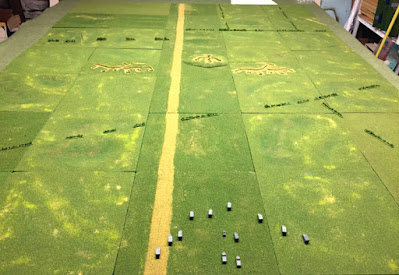
German view of the battlefield looking east.

Soviet view looking west.

The Battle

The Soviet NNKVD Company was deployed south of the road at the eastern edge of a lightly forested area surrounded by farm fields.  The Recce Company was deployed north of the central road along foliage lines separating farm fields.  

View looking to the northeast, showing NKVD troops dug south 
of the east-west road.

The Soviet Recce Company spread thin in the foliage lines 
separating fields north of the road.

The Germans advanced along the road, lead by the bicycle company of the 2nd Recce Btln of the 2nd ID.  Just the first German troops started to cross the little bridge of the creek, they spotted the Soviet Recce troops just north of the road and immediately started to deploy off road.

German troops advance east, the blurred sides of the bridge 
straddling the road in the distance above.

One platoon of bicycle troops deployed immediately north of the bridge, while two platoons moved south.  Both German company HQs deployed a little behind the trees to the north of the bridge, while the 7.5cm infantry guns deployed along the stream ahead of the HQ sections, and the 3.7cm anti-tank guns advanced to support the bicycle troops south of the road. 

The two Kfz 13 armored cars were temporarily held at the HQs, and two batteries of 10.5cm artillery awaited fire support orders.

German forces deploying and advancing.

The bicycle troops south of the bridge advanced from one field line to the next, until taking fire from the tree line in front of them.  Additionally, they took fire from Soviet recce troops north of the road, but took no casualties.

The Soviet recce troops started to receive fire from the German 10.5cm batteries and quickly took casualties at their southernmost point.  Immediately after this, the bicycle troops to the south started to take more fire from the tree line and the 10.5cm guns were re-directed to fire there.

The Soviet s lost two recce sections to the first couple 
volleys of 105s.


During this time, the German 3.7cm AT guns were moved into position south of the bicycle troops and began firing at the Soviet infantry positions in the trees.  Slowly, hits were scored against the NKVD troops dug in along the tree line.  The German 5cm mortar section tried to hit the Soviet positions also, but struggled to get within range.

To the north, the 7.5cm guns began firing at the Soviets in the field lines, while infantry on both sides sporadically engaged each other without causing much damage.  Eventually the infantry guns scored a couple of hits, as did the NKVD troops against the German bicycle troops south of the road.

Soviet fire from the tree line began to fade and the bicycle troops advanced.
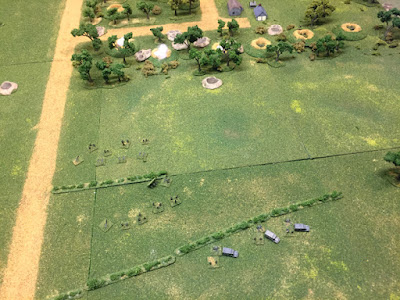
Bicycle troops advance, and the 3.7cm AT guns can be seen 
deployed near their trucks above. 

The bicycle troops eventually made their way to the tree line, while artillery and ATGs fired away at the soviet positions further south.  Soviet rifle fire killed a German rifle section and one ATR during the advance.


To the north, the German bicycle platoon moved north along the stream bed, and then east along the foliage and trees to gain better view and range on the soviet recce forces.  Additionally, the two infantry guns re-deployed further north on the west side of the stream to support the bicycle troops.
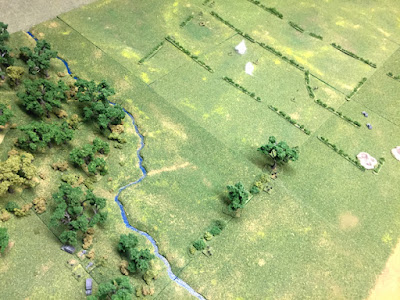

The German IG18s are visible in the bottom left above while 
the bicycle platoon has advanced along the trees extending east 
from the stream.

Between the infantry guns and the bicycle troops, the Soviets were slowly whittled away, during this time, the two Kfz 13s advanced down the road and swung north to encircle the Soviet recce troops.  The Soviet troops were unable to score any hits on the Kfz 13s, while taking a number of casualties, with several sections eventually surrendering to the armored cars.

The two Kfz 13s are barely visible center right above, 
closing in onthe withdrawing Soviet recce troops.


To the south, German troops advance into the Soviet fighting pits and exchanged fire with the NKVD troops.  In the face of the advancing German artillery, the southern most NKVD section eventually threw down their weapons and ran into the woods.  The remaining NKVD platoon in the woods along the road finally retreated after watching the Germans church their way forward and losing contact with their CHQ.

The abandoned NKVD positions in the woods south of the road.

The germans rounded up the Soviet prisoners in the field, tended to their wounded, and regrouped before continuing forward,


Losses

In all, the germans lost only two sections, one rifle, and one anti-tank rifle.  The Soviets lost both companies, with 8 NKVD sections killed, and 11 recce sections killed and the remaining five captured.  

In a state of panic, one NKVD section simply evaporated into the countryside, and the withdrawing platoon will likely either be shot by their own troops or overrun by these same Germans later in the day.


Other Tidbits

The Soviets did not experience the German pre-attack artillery bombardment, so were intact when the Germans discovered their presence. Tthe Germans on the bridge were sighted on the same turn that they first saw the Soviets, the Soviets simply had no weapons with which to hit the Germans at 800 plus meters range. 

Additionally, the Soviet 9th Infantry Brigade lost most of its headquarters in the early German air attacks, and could not receive notification of the  of the German advance here, nor could they offer any artillery or other support.

The Soviet recce troops could not disengage with the Germans, as once they were off-loaded, their trucks were moved far to the rear for other duties, as the Soviets are having severe transportation issues on this morning.


Thoughts

The Soviets were pretty much loced in to holding their ground, not having much flexability or hope.

From the German side, this battle progressed more like I might have expected, than the last.  Once the Germans located the Russians, they allowed their firepower to take out the enemy without putting many of their soldiers in harms way.  Losses were roughly 10:1 in this battle.

German 2nd Infantry Division will continue its morning advance, and will likely find more of the Soviet 9th Infantry Brigade blocking it's path to the east.


Hoping to get the next battle a little further south, in and around Grodno, on the table this week.


Monday, January 22, 2024

Barbarossa, Turn 1, June: AAR 2 - Lithuanian Border

The commander of the 13th NKVD Border Company stood over the shoulder of his radio operator, waiting for any instruction  He had expected either the arrival of reinforcements or an order to withdraw to a more defensible position, but neither came.  Around him the entire world began to explode, as German artillery landed.  Deafened by the sound of the explosions, the world suddenly went black.


The Battlefield

Set somewhere along the road entering southwestern Lithuania, the 13th NKVD Border Company was deployed straddling the road entering Lithuania in hex 2125 of the Fire in the East game map. It would soon be under attack by the German 101st Motorized Infantry Battalion.

Looking north, the Germans enter from the south edge, 
with the Soviets dug in in the distance.


Russian Forces

1x  NKVD Border Company

    1x CHQ

    3x Inf Pltn, each with 1x PHQ, 3x Rifle Section


German Forces

Elements of the 101st Motorized infantry Battalion, attacking forces consist of:

2x Motorized Infantry Company, each with:

    1x CHQ, ATR

    3x Mot Inf Pltn

        1x PHQ

        3x Rifle Section

    1x Sup Pltn

        1xPHQ

        2x MG section

        3x 5cm mortar

1x 7.5cm IG Btty

1x 8cm Mortar Btty


The Battle

The battle started with an artillery barrage that lasted a half-hour or more.  When it ended the company had lost its commander, as had one platoon, and four rifle sections were no more.  They would have surrendered, but there was no one yet to surrender to.

The German artillery took it's toll.

Minutes passed and much of the smoke cleared before the Germans could be seen coming down the road.  By this time one of the Soviet platoon commanders had sort of rallied the remaining forces, and all stood firm, waiting for the German onslaught.

The Germans advanced across the open, mostly level landscape.  The only cover were a bushes occasionally separating fields, and a few shallow depressions.  The Germans moved to the nearest line of bushes, dismounted and found some cover.

Not able to see any Russian activity, they began their advance over the open ground.  The infantry guns offered covering fire as did the 5cm and 8cm mortars.

The Germans advance.

The Soviets began firing once the Germans were within 600 meters, too far really to have any affect, not having any sort of heavy weapons, and giving away their positions.

Both sides take casualties.

German infantry guns and mortars began firing, wildly at first, but eventually settled down and began to inflict casualties.  During that time, the Soviets managed to destroy about a platoon of advancing German infantry.

Two of the German 7.5cm infantry guns.

Slowly the Germans managed to close with the last Soviet squad on the German right, destroyed it, and started to work their way through the artillery-wrecked trenches.  Mortars and guns finished off the Soviets in the center, the few Soviets to the left began to surrender, with some being shot and only one platoon headquarters managing to be taken prisoner.

Last of the Russians of the German right fall.

Germans moving west, clearing the trenches.


Losses

The Soviets lost the entire NKVD Company which started the battle with no heavy weapons and nearly down to 50 percent strength.

The Germans lost 5 rifle squads, a PHQ, and one MG section


Final Thoughts

After a year of build-up, it was something of an anticlimactic battle; though, I imagine that any campaign is bound to have some of these.

The Campaign maps for Fire in the East are kind of bare with respect to deriving terrain for a miniatures battle, so before setting up the game, I hopped on Google Earth to check out the general location for this battle, and it was pretty much flat and empty; not many buildings, practically no trees, etc.  Maybe the FitE maps were bare for a reason.

The combination of the small and relatively simple forces involved in the battle, the lopsided nature of the matchup, and the lack of cover combined with the small scale, left me feeling a little lost and somewhat intimidated.  The result was that I mostly ignored doctrine and tactics, just kind of bumbled through it, and found myself repeatedly thinking, "Wow, that was stupid".

I also nearly forgot to run the pre-game artillery barrage, actually advancing the Germans a few turns onto the table, before realizing my omission.  Fortunately the two sides were well out of range of each other, so it wasn't a problem conducting the barrage a little late.

Regarding the battle itself, the loss of the Soviet company commander, and two of the three platoon headquarters to artillery left them on the verge of surrender at the start of the battle.  They simply didn't have the resources to last very long.

All things considered, a bit of a bumpy start to the campaign. 


Sunday, January 21, 2024

Barbarossa, Turn 1, June: AAR 1 Initial German Air Attacks

The offensive started with German Luftwaffe attacks on Russian airfields and command hubs.  Losses were heavy for the largely unsuspecting Soviet forces, with 11 airfields being hit (one completely out of action), and four Brigade headquarters put out of action.  

In the early morning confusion, Soviet reaction was limited, with most forces awaiting orders from commanders, who were struggling to understand what was happening.

In this first phase of the conflict, the Germans destroyed 43 Soviet aircraft for the loss of 2 German aircraft.  Additional air attacks will continue as the turn progresses.


Even before the air missions had been completed, German ground forces had begun their attacks, starting with artillery bombardment against Soviet forces along the border.  Soviet forces were largely caught by surprise, not expecting the immediate attack despite the escalating tensions in recent weeks.

Those battles will be presented shortly.

Sunday, January 14, 2024

June 22, 1941 Operation Barbarossa Begins: Initial Set-up

After much interruption and chaos in the final months of 2023 and particularly during this last couple of weeks, Operation Barbarossa is finally underway.  I've got the Fire In The East Maps on the table, my homemade unit counters deployed, and am working out the initial air attacks.  

I don't have a 6mm airbase, nor enough miniature planes to fill one, so the airbase attacks will be resolved using the system presented in Barbarossa 25, while the intercepts will depend on the number of aircraft involved, should they happen.  Once the air combat is done, I'll move on to the ground battles.

Here is a pic of the map at some point during setup:

I think all of the counters are on the map here, 
though final adjustments hadn't been made when 
this pic was taken.

The Germans were deployed with Army groups Center and South more heavily weighted than in the actual attack, while on the Soviet side, the deployment is probably a more balanced.

I'm ignoring the very northernmost portion of the map, north of Lenningrad, as my map table is only seven feet long, and can't accommodate the upper half of the northernmost map, and i'm not including the Finnish forces (as I don't have the miniatures).

I expect to get through the turn 1 air combat during evenings this week, and hope to get the first land battles on the table next weekend.  Also, I can already see that I have some adtional bits to make. 

I'll start posting AARs as soon as possible.

Wednesday, January 10, 2024

Of Best Laid Plans...

So, during the Christmas break, I started setting up my 6mm Operation Barbarossa campaign on the map table,  and quickly realized that setting up was going to take much more consideration than I previously thought.

After spending nearly two weeks re-reading the lead-up to the offensive, considering what historical aspects to include, and where I could reasonably deviate from history without skewing things too badly, I set up the forces for the start of the game.  

I'm using the game maps from GDWs Fire in the East with custom made unit counters for the campaign.  I finished laying out the counters, set a number of small wood blocks around the edges of the map, and laid an acrylic sheet over the south half of the map.  I no sooner let go of the plastic, and maybe a hundred counters lifted off of the map and stuck to the plastic hovering 3/4 of an inch above the map.

"Oh, darn."

I lift up the plastic, tilted it a bit, and the counters slid down the plastic with a goodly number falling into a pile near the southern edge of the map.

"Crap."

So I sprayed an anti-static spray on the second sheet, laid it across the northern half of the map, and it happened again.

"Huh."

So now I have thousands of little men and tanks in the basement, eagerly awaiting their doom, while upstairs in the GHQ, a reserved, "Ummm?", is holding up the offensive.

The three cats who live here are fond of high places, and keeping them off of the table is simply not an option.  So, at the moment, I'm considering my options.

Sunday, January 7, 2024

6mm Russian Buildings for Barbarossa

Though I have a fair number of Russian buildings, I really need more city and industrial buildings.  I'll take a look at my German and French buildings and see if I can't hijack a few for service in Russia, but think I'm just going to break down and scratch build and cast a few to give a little more variety.

Thse are some of my most recent additions.  The first group are the city/industrial type buildings from Levin Miniatures and are quite nice:


The next group are smaller houses also from Levin:


These look a lot darker in the photos than they are in person.   I guess one of these days, I should actually set up lighting for taking photos.

Tuesday, January 2, 2024

15mm Air Support for Cold War British 1958

Here are a couple of aircraft for my 1958 Cold War British forces in 15mm.  The first is a Hawker Hunter from QRF, a model I picked up from a hobby shop during a trip to Tennessee many years ago.


Second is a De Haviland Venom diecast, originally in Italian markings that I repainted.  Both models were finished with decals from misminis.com.


I should probably do a couple of Soviet jets now that I'm thinking about it.